The Sani Solution: How Kaduna’s Governor is Single-Handedly Turning the Tide – A Story Worth Telling, Says Tom Garba

The Sani Solution: How Kaduna’s Governor is Single-Handedly Turning the Tide – A Story Worth Telling, Says Tom Garba

In a region once synonymous with ethno-religious strife, banditry, and insecurity, Kaduna State Governor Uba Sani has emerged as a transformative force, rewriting the state’s narrative with a vision of unity, peace, and progress.

In just two years since assuming office in May 2023, Sani has spearheaded reforms that have not only quelled violence but also fostered an unprecedented sense of togetherness among Kaduna’s diverse communities.

“This is a story worth telling,” declares Tom Garba, a prominent Kaduna publisher and proud son of the state, who marvels at the governor’s ability to turn the tide against decades of division and unrest.

Kaduna State, a microcosm of Nigeria’s ethnic and religious diversity, has long been a flashpoint for conflict in the Northwest. Tensions between Muslim and Christian communities, particularly in Southern Kaduna, coupled with farmer-herder clashes and rampant banditry in areas like Birnin Gwari and Giwa, once made the state a symbol of instability.

Markets were shuttered, farmers extorted, and communities lived in fear. Yet, under Governor Sani’s leadership, Kaduna is experiencing a remarkable renaissance, with peace returning to volatile regions and residents embracing coexistence.

“Governor Sani has done what many thought impossible,” Garba enthuses. “He’s united Kaduna in a way that’s inspiring the nation.”

A defining moment in Sani’s tenure came on June 15, 2025, when he presented a first-class staff of office to His Royal Highness Isiaku Tagwai Sambo, the newly installed Chief of Moro’a in Kaura Local Government Area.

The coronation, attended by dignitaries from across the state, was more than a ceremonial event—it symbolized Sani’s commitment to empowering traditional institutions as pillars of peace and unity.

Speaking at the event, Sani underscored the vital role of traditional rulers: “They are custodians of peace, drivers of grassroots mobilization, and key partners in policy implementation.”

His support for these institutions has been a cornerstone of his strategy to rebuild trust and foster collaboration among Kaduna’s diverse groups.

The “Kaduna Model,” Sani’s innovative non-kinetic approach to tackling insecurity, has been a game-changer. By combining disarmament, demobilization, and reintegration with investments in rural development and conflict resolution, Sani has addressed both the symptoms and root causes of violence.

The results are striking: on November 29, 2024, Sani reopened the Birnin Gwari livestock market, closed for a decade due to banditry, marking a triumphant return to economic normalcy.

Similarly, the revitalization of the Kidandan market in Giwa has boosted local commerce and restored community confidence.

“These are not just markets reopening,” Garba notes. “They’re symbols of hope, proof that Sani’s vision is working.”

Sani’s inclusive governance has been equally transformative. “I am not a governor for any religion or ethnicity; I am a governor for everyone in Kaduna,” he declared in a 2025 interview.

This ethos is reflected in his equitable distribution of resources, with 60% of the 26 completed road projects out of 79 initiated under his administration located in rural areas, benefiting communities across Northern, Central, and Southern Kaduna.

His administration’s engagement with both Muslim and Christian communities, exemplified by his attendance at the Christian Association of Nigeria’s Christmas Carol in December 2024, has dismantled the walls of segregation that once divided Kaduna.

“Kaduna town is no longer split between Muslims and Christians,” Sani remarked, urging residents to reject ethnic and religious bigots.

Southern Kaduna, long a hotspot for violence, has seen a dramatic turnaround. “No more killings in Southern Kaduna because I’m leading without religious or ethnic sentiments,” Sani stated in May 2025.

His inclusive approach has earned praise from religious leaders like Rev. Dr. Ayuba Malam Job Bagat, President of ECWA Worldwide, who noted that Sani’s leadership has provided “succor to Southern Kaduna, which was almost totally neglected in past regimes.”

Alhaji Abubakar Mustapha of the Kaduna Elders Forum echoed this sentiment, hailing Sani for making Kaduna “a shining example of ethno-religious harmony.”

Traditional leaders have been central to Sani’s success. By empowering figures like the Chief of Moro’a, who pledged to lead with transparency and unity at his coronation, Sani has strengthened community-level governance.

“We shall work together as one united family,” the new chief declared, aligning with Sani’s vision. This partnership has facilitated intelligence-sharing and community cohesion, contributing to Kaduna’s newfound stability.

“The governor’s respect for traditional institutions is a masterstroke,” Garba says. “It’s brought governance closer to the people.”

Beyond security, Sani has addressed Kaduna’s infrastructural and human capital deficits. His administration has upgraded 62 primary health centers to Level 2 status, improving healthcare access, particularly in rural areas.

Critical road projects have enhanced connectivity, spurring economic activity. “Kaduna is once again a united people,” a Kaduna resident said, reflecting widespread public support.

Garba agrees: “Sani’s reforms are not just about security—they’re about giving every Kadunan a stake in the state’s progress.”

Sani’s achievements have earned him national recognition, including the 2024 Governor of the Year award from a leading Nigerian newspaper. “This is a leader who listens, acts, and delivers,” Garba says.

“Kaduna’s story under Sani is one of hope, unity, and progress—a story worth telling.” By fostering trust across ethnic and religious lines, investing in development, and empowering communities, Governor Uba Sani is not only transforming Kaduna but also setting a blueprint for other states. As Kaduna moves forward, the “Sani Solution” stands as a testament to what visionary leadership can achieve in the face of adversity.
TIME FOR A BOLD STEP: Vice President Kashim Shettima Should Leave the APC with Honour

TIME FOR A BOLD STEP: Vice President Kashim Shettima Should Leave the APC with Honour
From Lateef Taiwo

An Abuja based legal practitioner and human rights activist, Barrister Hamza N Dantani, has described the All progressive Congress( A PC ), North East Zonal meeting in Gombe on Sunday as an affront to Vice president Kashim Ibrahim.
“In a press statement made available to newsmen in Abuja on Sunday, Hamza stated that the gathering of the North east Zonal stakeholders forum in Gombe, where an endorsement was made for president Ahmed Bola Tinubu’s 2027 election bids without the mention or inclusion of Shetima sent an obvious political message to vice president Kashim shettima- we do not need you any more”

According to the constitutional Lawyer and Right activist it appears the ruling party or potent forces within are gradually edging out the vice president who was central to their victory in 2023″

The respected Legal luminary called on the Vice president shettima- to leave the All progressive Congress, ( APC), with his honour intact.
While extolling the vice president for his political sagacity that culminated in the victory of the All progressive Congress ( APC), in the presidential election in 2023 , Hamza went memory lane

“As a Patriotic Citizen of this great Country, Nigeria, and a law-abiding observer of Nigeria’s political landscape, I have followed Vice President Kashim Shettima’s political journey with great admiration and pride. From his days as a commissioner to his transformational leadership as a two-term governor of Borno State, to his impactful tenure in the Senate, and now as Vice President of the Federal Republic of Nigeria, Kashim Shettima has consistently proven to be one of the most refined, articulate, and visionary politicians in contemporary Nigeria.”

“In May 2025, 22 All Progressives Congress (APC) governors endorsed Tinubu as the sole 2027 presidential candidate without mentioning the vice president. In May, APC Northwest zone stakeholders emphatically endorsed Tinubu as their sole candidate for the 2027 elections without including the vice president. In doing so, the party sent a subtle message to Vice President Kashim Shettimaㅡ: We do not need you anymore”.

“However, today’s gathering of the APC Northeast zonal stakeholders forum in Gombe, where an endorsement was made for President Bola Ahmed Tinubu’s 2027 re-election bid without the mention or inclusion of Vice President Shettima, sends an obvious political message. It appears that the ruling party, or at least its most potent forces, are gradually edging out a man central to their victory in 2023.”

“This is not just an affront to Shettima as an individual; it is an affront to the Northeast, to Borno, and to all Nigerians who believe in fairness, competence, and loyalty in politics.”

“Let us not forget: in 2023, Shettima traversed the North, defended the party, and brought intellectual weight and political credibility to the Tinubu campaign. His role was not ceremonial. He fought, he campaigned, and he delivered for the ticket. The North, particularly the Northeast, rallied behind the ticket partly because of his involvement. Today, however, the handwriting on the wall is glaring — the APC may be preparing to drop him as the running mate in 2027.”

“It is painful but not surprising. Politics in Nigeria is often about expediency rather than principle. But this is precisely why leaders must know when to draw a line. Vice President Kashim Shettima must not allow himself to be used and discarded. He must not sit quietly in the backseat while decisions are made to sideline him” he lament

“Now is the time to leave the APC.

He must do so with his head held high, not in bitterness, but with the clarity and dignity of a man who knows his worth and refuses to be politically humiliated. Leaving the APC now, while the ovation is still loud, will send a strong message — that he is not a political appendage but a force in his own right—a man whose influence transcends party structures and who still commands enormous goodwill across the North and beyond”

” Shettima’s political future does not begin and end with the APC. His pedigree and vision are far too important to be boxed in by a party that no longer sees his value. He has the capacity, credibility, and following to chart a new political course, whether within a new alliance, movement, or party”

“The North, particularly the Northeast, looks up to him. Borno holds him in high esteem. Nigeria needs his voice in the coming years. He must not diminish himself by clinging to a political structure that appears to have moved on without him”

“History will be kind to Kashim Shettima if he chooses courage over comfort. And if the Almighty wills it, he will become the president of this country shortly. It is time to show that he is not a political orphan but a statesman who can still shape the destiny of this nation, with or without the APC.”
Reacting to the rowdy out come of the Zonal stakeholders meeting in Gombe, Governor Zulum of Borno state also warned the party against any move to
dump vice president shettima, according to him the entire North east are behind vice president shettima.

A Father’s Day Message to All Men Across the World — Especially Nigerian Men- FADOJOE

A Father’s Day Message to All Men Across the World — Especially Nigerian Men
By Faduri Oluwadare Joseph (Fadojoe)
Former Presidential Aspirant | Founder, Rescue Movement for a New Nigeria

My dear brothers, fathers, and leaders of families across the world,

On this special occasion of Father’s Day, I extend my deepest respect, appreciation, and heartfelt greetings to every man — from the streets of Lagos to the corners of rural Africa, from the cities of America to the towns of Europe and Asia — who has taken up the sacred responsibility of fatherhood, mentorship, and leadership.

To all Nigerian men, this message is especially for you. In a nation tested by challenges, yet blessed with resilience and greatness, your role as a father has never been more crucial. You are the builders of families, protectors of communities, and the silent strength that holds our society together.

Fatherhood is not just about biological connection. It is about sacrifice, discipline, integrity, compassion, and vision. It is about raising children who will not have to recover from their childhood. It is about leading by example, even when the world offers little reward. It is about showing up, staying strong, and believing in the better tomorrow that we all seek.

As a political leader and a fellow father, I see your struggles. I understand the pressures, the disappointments, and the sacrifices. But I also see your courage, your endurance, and your undying hope. It is that hope that will rebuild our country. It is that hope that will reshape Africa.

Let us remember today that being a father also means being a nation builder. We must rise to reject every form of corruption, oppression, and injustice. We must raise our voices and take action to rescue our nation — not just for us, but for the children who look to us with trust in their eyes.

To all the single fathers, the grandfathers, the mentors, the uncles, and the male guardians — we see you. We celebrate you. We honor you.

May this Father’s Day renew your strength and your sense of purpose. May it remind you that your love, your presence, and your values matter more than words can express.

Together, we will build a New Nigeria, a better Africa, and a brighter world — starting with the families we lead.

Happy Father’s Day.
God bless you, and God bless the fathers of Nigeria and the world.

Time to Rescue Our Democracy:Local Government Elections in Osun State and the Shame of Two Parties- FADOJOE

Time to Rescue Our Democracy:
Local Government Elections in Osun State and the Shame of Two Parties
By Faduri Oluwadare Joseph
Former Presidential Aspirant (Labour Party),Founder, Rescue Movement for a New Nigeria


For a long time, I have chosen not to meddle in the political affairs of my home state, Osun. As someone from the opposition, I’ve sought to avoid being perceived as biased in the tussle between the two dominant parties — the All Progressives Congress (APC) and the People’s Democratic Party (PDP). But the recent show of shame between these two parties in the ongoing local government crisis demands that I speak up. What is happening is not just politics — it is a threat to democracy itself.

Democracy is meant to reflect the will of the people. It should be rooted in fairness, justice, and credibility. But what we are seeing in Osun State — and across Nigeria — is a betrayal of these values. Our local government elections have become a caricature of democracy, a disgraceful display of manipulation and illegality.

APC and the Beginning of the Shame

Under the administration of former Governor Adegboyega Oyetola (APC), a local government election was conducted — but let us be clear, it was not an election in any democratic sense. The name of a valid political party, the Action People’s Party (APP), was missing from the ballot paper. Voters were given a simple “Yes or No” choice — not actual candidates. What kind of election is that?

This was not democracy; it was a stage-managed fraud. The APC government at the time imposed a process devoid of legitimacy and declared winners. That sham should never have stood. The eventual removal of those chairmen and councillors was necessary — but what followed under the PDP has proven no better.

PDP and the Jungle Election

Governor Ademola Adeleke came into office and swiftly sacked the APC-installed officials. He then organized his own “election” — but what followed was a jungle drama.

In some towns, ballot boxes were allegedly taken to the bush, where unknown individuals thumb-printed in secrecy. In many areas, voting reportedly concluded before 7:00 AM — how is that even possible? Some called it a kangaroo election, others an “emergency democracy.” But no serious democratic process would operate like that.

To make matters worse, the head of the Osun Independent Electoral Commission (OSIEC), Mr. Hashim Abioye, is a known PDP member and former House of Assembly aspirant. Can anyone seriously expect neutrality from such a figure?

Courts, Chaos, and Confusion

As if the elections weren’t chaotic enough, conflicting court rulings have now plunged the state into deeper confusion. The Court of Appeal in Akure and the Federal High Court in Osun have issued contradictory judgments over who should be in office. On June 13th, yet another unclear judgment was delivered — prompting both APC and PDP to rush to declare victory.

This confusion is dangerous. Already, lives have been lost in previous clashes over reinstatements. If nothing changes, more blood may be spilled.

Security agencies are failing to uphold neutrality and professionalism. The Inspector General of Police and the Attorney General are facing allegations of bias. The judiciary, too, must speak with clarity and act with integrity — their silence and ambiguity only fuel the chaos.

President Tinubu Must Act

President Bola Ahmed Tinubu must not stand by in silence. This is beyond partisan politics. As the leader of this nation, he must rise above affiliations and intervene decisively. Democracy is on fire in Osun State, and inaction is no longer acceptable.

A Word to Governor Adeleke

Governor Adeleke, I urge you: do not take the law into your own hands. You are the executive, not the judiciary. Respect the courts, even in their confusion. Do not instruct chairmen or councillors to resume office without clear and final legal directives. Let the rule of law, not politics, guide your actions.

A Message to Security Agencies

Your loyalty is to the people of Nigeria — not to any political party. Protect our citizens. Uphold the law. Be fair. Be professional. We are watching.

A Call to Nigerians

Fellow Nigerians, this is a wake-up call.

We must reject Yes/No elections. We must denounce kangaroo voting and bush ballot boxes. We must demand real elections — free, fair, and credible.

This is not about APC or PDP. It is about our collective future. Until we fix our local government elections, we cannot build the New Nigeria we all dream of.

Let us rise. Let us speak out. Let us demand justice, transparency, and accountability. It is time to rescue our democracy — and time to rescue Nigeria.
And it all begins with everyone of us.

Enough is enough.

Democracy Day: Tinubu Confers Honours on Uba Sani, Shehu Sani, Others

Democracy Day: Tinubu Confers Honours on Uba Sani, Shehu Sani, Others

President Bola Ahmed Tinubu has honoured prominent Nigerians, including Kaduna State Governor Senator Uba Sani and former lawmaker and rights activist Senator Shehu Sani, for their pivotal roles in the struggle for democracy in Nigeria.

Speaking during the 2025 Democracy Day celebration on June 12, President Tinubu acknowledged the sacrifices made by several pro-democracy advocates during Nigeria’s years under military rule. In a speech delivered before a joint session of the National Assembly, the President commended the bravery and enduring commitment of individuals like Uba Sani and Shehu Sani in advancing democratic ideals.

“These patriots stood firm when it mattered most,” Tinubu said. “Their courage helped shape the democratic foundation we stand on today.”

As part of the commemorations, President Tinubu conferred national honours on several distinguished Nigerians for their contributions to the democratic journey. The list includes academics, journalists, politicians, civil society leaders, and posthumous awardees.

Key honourees include:

Prof. Wole Soyinka – Grand Commander of the Niger (GCON)
Senator Shehu Sani – Commander of the Order of the Niger (CON)
Governor Uba Sani – Commander of the Order of the Niger (CON)
Bishop Matthew Hassan Kukah – CON
Barrister Femi Falana, SAN – CON
Dapo Olorunyomi (Publisher, Premium Times) – Officer of the Order of the Niger (OON)
Bayo Onanuga (Presidential spokesman) – CON
Ken Saro-Wiwa (Posthumous) – CON
Alhaja Sawaba Gambo – CON
Chief Bola Ige – CFR
Mobolaji Akinyemi – CFR
Others honoured include rights activists, lawmakers, journalists, and late pro-democracy campaigners such as Rear Admiral Ndubuisi Kanu, Balarabe Musa, Chief Frank Kokori, and Odia Ofeimun.

The recognition, Tinubu said, is part of a broader effort by the federal government to memorialize the efforts and legacies of those who played vital roles in shaping Nigeria’s democratic evolution.

Broken Promises, Stolen Futures: The Call for a New Nigeria on Democracy DayJune 12: A Wake-Up Call to Real Democracy in Nigeria

Broken Promises, Stolen Futures: The Call for a New Nigeria on Democracy Day
June 12: A Wake-Up Call to Real Democracy in Nigeria
By Faduri Oluwadare Joseph (FADOJOE)
Founder, Rescue Movement for a New Nigeria | Former Presidential Aspirant, Labour Party

Today, June 12, we commemorate Nigeria’s Democracy Day — a day not only to honor the memory of Chief MKO Abiola and the historic 1993 elections, widely acclaimed as the freest and fairest in our history — but also to confront the hard truth of where we stand as a nation.

We are called to celebrate democracy, yet we have not truly practiced it.

What is democracy if not a government by the people, for the people, and with the people?
Sadly, what we witness today in Nigeria is a far cry from that ideal. Instead of genuine democracy, we are burdened with corruption, injustice, insecurity, and a political system that fails the very people it claims to serve.

We cannot continue to call this democracy when:

Votes are bought with rice and naira, not earned through trust.

Electoral victories are decided by rigging, not the will of the people.

The same recycled elite hold us hostage while the masses suffer in silence.

Our judiciary shields the rich and powerful while oppressing the poor.

Law enforcement serves those in power, not the people.

Insecurity, kidnappings, and fear have become part of everyday life.

Whistleblowers are silenced while looters walk free.

This is not democracy. This is betrayal — of our heroes past, our youths present, and our children’s future.

But amid the darkness, there is hope.

There is still time to rewrite the story of our nation — to build a New Nigeria defined by justice, equity, opportunity, and peace. But the journey begins with us.

How do we build real democracy?

  1. Vote Wisely:
    Your vote is your voice. Stop exchanging it for peanuts while they steal your tomorrow. Vote for people of character, competence, and compassion — not for names, parties, or tribes.
  2. Unite Beyond Religion and Tribe:
    Until we begin to see ourselves as Nigerians first — not Igbo, Hausa, Yoruba, or any other ethnic group — we will remain divided and weak. Our real enemies are not each other, but the corrupt leaders who exploit our divisions to maintain power.
  3. Participate Actively:
    Whether you are in Nigeria or abroad, your voice, your skills, your resources matter. We need all hands on deck. Change is not a solo effort. Not by me. Not by you. But by all of us — together.

Imagine This Nigeria:

Where a roadside hawker’s child has the same quality education as a senator’s child.

Where a police officer knows that breaking the law comes with consequences.

Where elections are contests of ideas, not intimidation.

Where governance is a sacred trust, not a personal business.

That Nigeria is possible. That Nigeria is necessary. That Nigeria is our duty.

So this Democracy Day, let’s do more than celebrate — let’s reflect, recommit, and rise.

Let us raise one voice and one purpose — to rescue Nigeria from failed leadership and broken promises, and usher in the era of true democracy.

It starts with you. It starts with me. It starts with all of us.

Happy Democracy Day, Nigeria.
Let’s make it real.

EX-COUNCILORS HAIL NUHU RIBADU FOR CHECKMATING INSECURITY IN NIGERIA

PRESS RELEASE

EX-COUNCILORS HAIL NUHU RIBADU FOR CHECKMATING

INSECURITY IN NIGERIA

As the Nation celebrates the 2025 edition of the annual Democracy Day anniversary, Former Councilors in Nigeria Operating under the aegis of National Forum of Ex-councilors has applauded the achievements of the National Security Adviser, Mallam Nuhu Ribadu in taming insecurity across the six geo-graphical zones of Nigeria.

The Ex-councilors spoke through their·National President Hon.Amb.Auwal

Kasim Hassan who addressed a press conference in Kaduna on Thursday,June

12,2025 to commemorate the June 12 Democracy Day celebrations.

The grassroot politician who was accompanied by top officials of the association enumerated the achievements recorded by Mallam Nuhu Ribadu as follows:-

He said when Nuhu Ribadu assumed office as Nigeria’s National Security Adviser on June 26,2023,he inherited a nation besieged by multifaceted security

threats:terrorism in the   Northeast,rampant banditry in the Northwest,separatist violence in the Southeast,and a kidnapping economy flourishing nationwide.

Against this backdrop,Ribadu a former police officer and pioneer chairman of

the Economic and Financial Crimes Commission (EFCC)brought a paradigm

shift to Nigeria’s security architecture.His doctrine,articulated early in his tenure,rejected orthodox solutions in favor of a tripartite strategy merging

military precision,political dialogue,and socio-economic initiatives.With an emphasis on interagency coordination,intelligence-driven operations,and regional partnerships, Ribadu’s first two years have redefined leadership at the Office of the National Security Adviser (ONSA).

He added that Mallam Nuhu Ribadu also ensured the implementation of the

following:

1.   Curbing Oil Theft &Economic Sabotage

·Achievement:Coordinated aggressive operations against illegal refining

sites and pipeline vandalism in the Niger Delta.

Impact: Nigeria’s oil production rose from 1.1 million barrels/day (mid-2023)to 1.6 million barrels/day(Q12024)boosting revenue by N1.3 trillion monthly (NNPC data).

·Over 5,000 illegal refineries dismantled;1,800 suspects arrested.

·Restored investor confidence in the energy sector.

2.  Degrading Terrorism &Banditry

·Achievement:Revamped inter-agency coordination(military,police,

DSS)and intelligence sharing.

Impact:Bandit/kidnapping incidents fell by 40%in Northwest Nigeria(Q42023-

Q12024).

·Key terrorist leaders neutralized e.g.,Boko Haram’s Abu Illiya and many

others.

·Over 2,000 hostages rescued since 2023.

3.  Tech-Driven Security Modernization

·Achievement:Launched the National Security Data Fusion Centre

(December 2023).

Impact:

·Real-time threat analysis via AI and satellite monitoring.

·Faster response times to kidnappings e.g.,Kaduna school abduction

resolved in 48 hours.

4.  Regional Security Diplomacy

·Achievement:Strengthened partnerships with Niger,Chad,and Cameroon

for cross-border operations.

Impact:

·Reduced terrorist/bandit migration across borders.

·Joint operations neutralized 300+insurgents (Lake Chad Basin).

5. Addressing Farmer-Herder Conflicts

·Achievement:Mediation and rapid-response deployments in hotspots like

Plateau,Benue,etc.

Impact:

·60%reduction in fatal clashes in 2024 vs.2023(SBM Intelligence).

● Enhanced community-policing frameworks.

Similarly,he disclosed that the National Security Adviser milestones as National

Security Adviser(2023-Present)underscores that effective security leadership

hinges on strategic coordination,unflinching political backing,and silent,result-

oriented action.His decimation of terror kingpins from Boderi to Kachalla

Damina has disrupted criminal ecosystems that once operated with impunity.His revitalization of ONSA’s specialized centers (NCTC,NCCC)has

institutionalized resilience against emerging threats.Yet,Ribadu’s legacy

extends beyond statistics:it lies in rebuilding trust between security agencies, across borders,and among citizens.Challenges persist,as noted in isolated clashes in Plateau or the 2024 resurgence of Lakurawa terrorists.

However, Ribadu’s insistence that ‘security is the foundation of national development’has set Nigeria on a trajectory where stability is increasingly conceivable.As he declared in his 2025 New Year address,the path forward demands ‘vigilance, collaboration,and unwavering unity’.With continued presidential support and public solidarity,the groundwork laid under Ribadu offers a template for a safer,

more sovereign Nigeria.

Concluding,Hon.Amb.Auwal Hassan Kasim affirmed the solidarity of National

Forum of Ex-councilors with Mallam Nuhu Ribadu vision for a safer,prosperous Nigeria.

Signed:

Hon.Amb. Auwal Kasim Hassan

National President.

08023444205

National Honour Validates Uba Sani’s Visionary Reforms – KADGIS DG

National Honour Validates Uba Sani’s Visionary Reforms – KADGIS DG

The Director-General of the Kaduna Geographic Information Service (KADGIS), Dr. Bashir Ibrahim as hailed the national honour bestowed on Governor Uba Sani as Commander of the Order of the Niger (CON), describing it as a “fitting reward for a reformer who has elevated Kaduna’s land governance to global best practices.”

In a congratulatory statement, Bashir said the honour, announced by President Tinubu during a joint session of the National Assembly, affirms the governor’s enduring impact in both democratic activism and modern governance.

“Governor Uba Sani is not only a democrat of repute but also a technocrat in action. Under his leadership, KADGIS has transformed into a digital-first, service-driven agency that puts citizens first,” he stated.

The DG praised the governor’s determination to sanitise land administration, improve revenue collection through efficiency, and restore public confidence in the system.

“Kaduna is now a model of data-driven land reform and urban planning because of His Excellency’s foresight. This national recognition simply validates what we already know — that Uba Sani is a man of vision and integrity,” Maikudi added.

He pledged KADGIS’s continued commitment to supporting the governor’s development agenda and ensuring the people reap the benefits of transparent land governance.

Blame Yourself, Not Others, for Labour Party’s Failure — A Message to Mr. Peter Obi

Blame Yourself, Not Others, for Labour Party’s Failure — A Message to Mr. Peter Obi

By Faduri Oluwadare Joseph (FADOJOE)

Former Presidential Aspirant, Labour Party founder, Rescue Movement for New Nigeria

My attention has been drawn to numerous comments and videos where Mr. Peter Obi continues to blame everyone but himself for the deepening crisis in the Labour Party. From blaming the current president to party leadership and even external forces, Obi seems to be pointing fingers everywhere except at the man in the mirror.

This is both disappointing and disingenuous.

It is laughable that a man who prides himself on competence, capacity, and production — the core vision of the Labour Party — is today a symbol of division, confusion, and underperformance. I recently watched a video where he accused the president of being responsible for the party’s woes. In another, he blamed the party leadership. The blame game is endless.

Let us call a spade what it is: the only person to be held responsible for the Labour Party’s downward spiral is Mr. Peter Obi himself.

When Obi joined the party in 2022, Labour Party was united. The house was in order. But since his arrival, crisis has rocked the party from top to bottom. The center could no longer hold. This division contributed heavily to our loss in the 2023 general election. A house divided against itself cannot stand.

How can a man who claims he wants to govern a complex nation like Nigeria not even manage a small political party?

To all Obi supporters, I ask you to think critically: If Peter Obi cannot resolve party-level crises, how will he manage inter-state conflicts, economic restructuring, security turmoil, and national reconciliation?

Let us not forget, Obi did not build APGA — the platform that gave him his first opportunity. He deserted it when he should have grown it into a national party, like Nnamdi Azikiwe did with NCNC or Awolowo with UPN. Compare that to Asiwaju Bola Ahmed Tinubu who turned a regional party into a national powerhouse that now governs Nigeria.

Instead of strengthening APGA, Obi ran to PDP for another political meal, then moved again to Labour Party for a third helping — always looking for the easiest path, not the one requiring true leadership and sacrifice.

After the 2023 elections, instead of returning to rebuild Labour Party and unify aggrieved members, he further distanced himself from Barr. Julius Abure — the very man he used during the campaign. Now that the party is in ruins, he blames Abure for the dirt, forgetting he was the one who walked into a clean house and messed it up.

Let me be clear: I am no fan of Julius Abure, but the shady deals now under scrutiny were made for Obi’s political ambition. Leadership requires loyalty, responsibility, and the will to lead — especially in difficult times.

Instead, Obi is fixated on joining coalitions — seeking shortcuts to power again. But let me boldly state: Mr. Obi is not qualified to be a coalition candidate for 2027. That position must be earned through proven leadership, party unity, and capacity — not mere popularity or public sympathy.

In 2022, Labour Party was dead asleep. I, Fadojoe, with the Rescue Movement, helped wake it up and gave Nigerians an option. The people were already disillusioned with APC and PDP. Obi benefitted from this public frustration — not because he was a political messiah, but because he was a lesser-known alternative.

Now, the reality has dawned on many. People are beginning to see beyond the media image. They ask — what does Peter Obi actually stand for?

Where does he stand on Nnamdi Kanu’s detention?

What is his position on the Sit-at-Home economic shutdown in the Southeast?

What has he said about oil theft in the Niger Delta?

What is his solution to insecurity — Boko Haram, unknown gunmen, and armed herders?

On all these pressing national matters, Peter Obi remains silent. But on universally agreeable issues like unemployment and poverty, he speaks loudly — because they are “safe zones.”

Leadership is not about where you stand during peace and applause, but where you stand in crisis and reproach.

Would Tinubu blame Labour Party for APC’s problems? Would PDP shift blame to the ruling party for its internal fights? No. So why should Obi not own up after two years in LP?

If you cannot lead, step aside.

Let those of us who have the vision, the capacity, and the courage to build a united and purpose-driven Labour Party take over. Reorganizing this party is not rocket science. Fixing Nigeria starts from fixing ourselves, our political parties, and our communities.

In 2027, Nigerians must choose a leader not based on sentiments or moral branding, but on vision, capacity, and competence.

We must bring about a generational shift in power. It’s time for a new leadership that doesn’t exploit tribal sentiments but promotes unity, development, and progress.

Many Nigerians in the diaspora have lost hope. Some have sworn never to return. But I say to you — don’t give up. There is still hope. Nigeria will rise again.

We will rebuild. We will recover. We will overtake.

Let’s not wait for a savior. Let’s become the saviors our country needs. The fight for Nigeria’s future begins with you and me. Together, let’s work for a better nation — starting now.

God bless you.

God bless me.

And may God bless the Federal Republic of Nigeria.

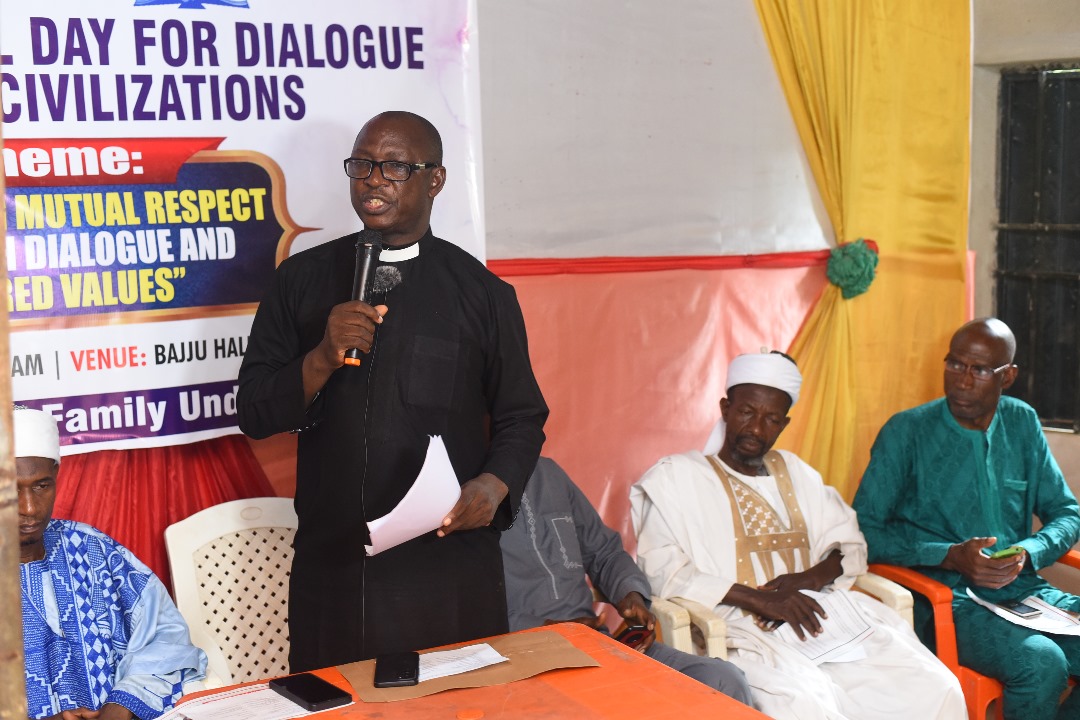
Int’l Day For Dialogue: Sustained Community-Based Engagement Key to National Unity – Global Peace

Int’l Day For Dialogue: Sustained Community-Based Engagement Key to National Unity – Global Peace

By Austine Agbo Emmanuel, Kaduna

Global Peace Foundation Nigeria (GPFN) has emphasised the need for sustained community-based dialogue as a cornerstone for fostering national unity, especially in a country as diverse as Nigeria.

This call was made in Kaduna on Wednesday during a high-level roundtable convened to commemorate the International Day for Dialogue Among Civilizations.

The event brought together religious leaders, women advocates, youth groups, and civil society actors to deliberate on the role of grassroots engagement in promoting peace and mutual understanding.

In his opening remarks, the Country Director of GPFN, Rev. John Joseph Hayab, described dialogue as more than just a tool for resolving conflict, stressing that it must become a way of life in communities historically divided along religious, ethnic, and political lines.

“Dialogue is the bridge that connects people, dispels fear, and builds trust,” he said. “In places like Kaduna, where identity is often politicised, we must intentionally create platforms for ongoing conversation at the grassroots. Peace cannot be imposed; it must be nurtured from the community level upward.”

Themed “One Family Under God: Advancing Peace through Dialogue in Local Communities,” the roundtable featured presentations and experience-sharing sessions on faith-based mediation, youth engagement, and intercultural understanding.

Speaking on “Fostering Mutual Respect Through Dialogue and Shared Values“, Hayab reiterated the foundation’s vision of building a united society through the principle of shared humanity.

He urged Nigerians to shift from reactive peace talks to proactive, structured dialogue that empowers faith leaders, amplifies women’s voices, and channels youthful energy towards national cohesion.

“As we mark another Democracy Day season in 2025, it is time to reflect on how inclusive dialogue can deepen our democratic culture and strengthen national unity,” he added.

Commending local peace actors across Kaduna and beyond, Hayab acknowledged their tireless efforts despite limited resources and called for increased support for community dialogue structures.

The programme also featured goodwill messages from key stakeholders. Chairman of the Christian Association of Nigeria (CAN) in Kaduna State, Rev. Caleb Ma’aji, Jama’atu Nasril Islam (JNI) Secretary General, Ibrahim Kufena, who lauded GPFN’s interventions in communities such as Hayin Bankin.

They noted that the foundation had invested significant time, resources, and compassion in building peace, urging residents of the area to sustain the gains by living peacefully and embracing shared values that promote unity. “You have the responsibility to drive development by living as one family under one God,” the clerics stated.

On his part, the Village Head of Hayin Banki, Alhaji Mahmud Shehu Galadima, emphasised the power of dialogue in building consensus. “What you cannot achieve through force, you can achieve through dialogue. I call on other communities to adopt this approach,” he said.

One the participants, Adama Ibrahim, praised the transformation in Hayin Bankin, describing it as a model for other communities. “We have seen positive change here because of GPFN’s efforts. I encourage others to replicate this example by fostering mutual respect and peaceful coexistence,” she said.

The International Day for Dialogue among Civilizations is observed globally to promote peaceful resolution of conflicts and deepen understanding across social, cultural, and religious divides.

Rev. Hayab closed the session with a charge: “Let us take the message of dialogue into our homes, markets, schools, and places of worship. When dialogue thrives, peace follows.”

Create your own website, free on WordPress.com.Create your own website.
Start free